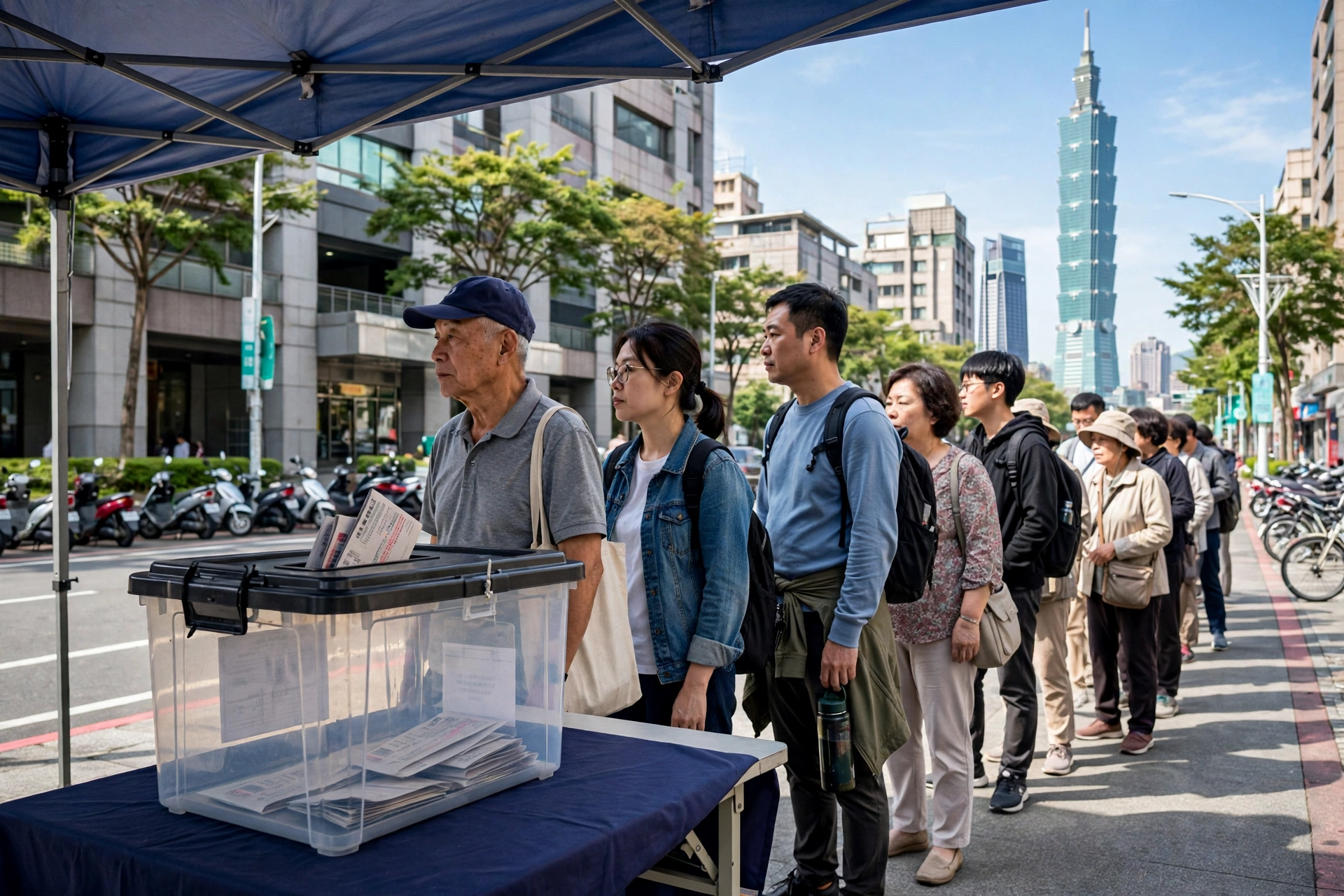
TAIPEI — Voters across Taiwan went to the polls on Saturday in local elections widely seen as a midterm test for President Lai Ching-te and his ruling Democratic Progressive Party, alongside a nationwide referendum on whether to bring back nuclear power.
Nearly 19.6 million people were eligible to vote for more than 11,000 local officials, including the mayors of Taiwan’s six largest cities — Taipei, New Taipei, Taoyuan, Taichung, Tainan and Kaohsiung — as well as mayors and magistrates in 16 other cities and counties. Polling stations were open from 8 a.m. to 4 p.m. local time, with the first results expected on Saturday evening.
The most closely watched contest is in the capital, Taipei, where incumbent Mayor Chiang Wan-an of the opposition Kuomintang (KMT) faces Democratic Progressive Party legislator Puma Shen. The outcome is expected to shape the political landscape ahead of the 2028 presidential election.
Voters are also deciding a referendum on whether the government should abandon its “nuclear-free homeland” policy and return to nuclear power, amid rising electricity demand from the semiconductor and artificial intelligence industries. Taiwan stopped generating nuclear power in May 2025, when its last operating reactor, at the Maanshan plant, was shut down. For the referendum to pass, yes votes must outnumber no votes and reach at least a quarter of all eligible voters — about five million people.
President Lai cast his ballot in Tainan on Saturday morning. Taiwan’s defence ministry said it had detected 33 Chinese military aircraft and 12 ships operating around the island during the vote.
Vote counting was expected to conclude by midnight local time, with the referendum result possibly announced later.